Unlocking Base Metal Potential in the Upper Gascoyne
Grade
Historical drilling confirmed anomalous base metal mineralisation, including up to 15m @ 0.2% Zn, with strong indicators for IOCG and sulphide systems
Scale
93.54km² exploration tenure covering a major structural corridor with untested airborne EM conductivity anomalies
Address
Located in the Edmund Basin, Western Australia, within the highly prospective Upper Gascoyne region adjacent to the Tangadee lineament
Potential
Underexplored system with strong geological similarities to nearby major deposits including Abra and Brumby-style HEBS mineralisation, with significant upside for new discoveries
Project Highlights
Emerging Base Metal System in the Bangemall Project, WA
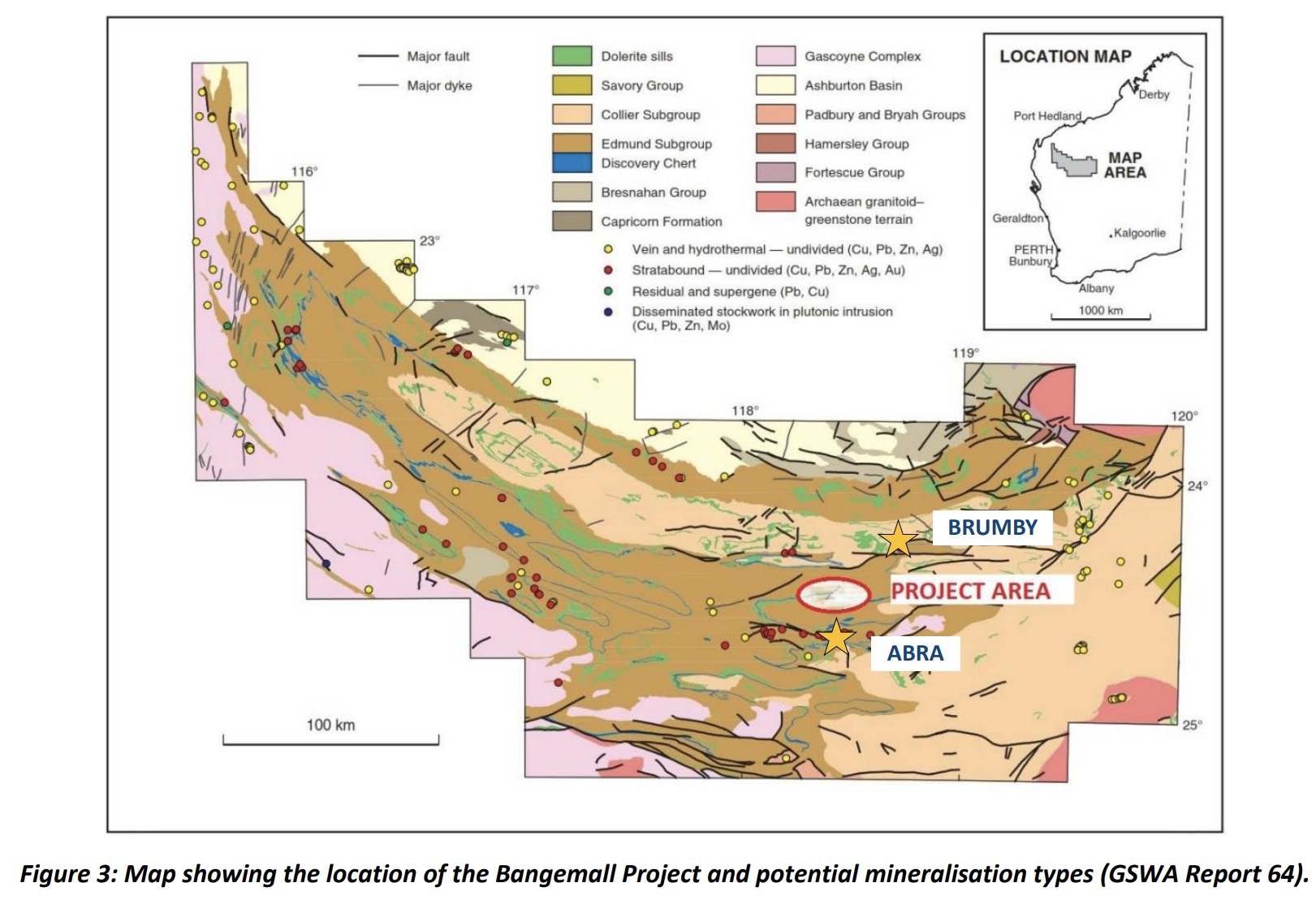
The Bangemall Project (being exploration licence E52/4393) covers 93.5km² within the Edmund Basin, in Western Australia’s Upper Gascoyne Region. The Project area overlies part of a major deep tapping northeast trending fault and shear trend in the basement, parallel to the regionally significant Tangadee lineament, and represents an ideal plumbing system for delivering mineralising fluids via buried suture granites. The tenure has seen limited previous exploration, with the most significant being work undertaken by Rio Tinto Exploration (RTX) prior to 2000. RTX generated a base metal stream sediment anomaly and drilled two RC holes into a carbon-rich shale. The RC holes intersected anomalous base metal mineralisation of up to 15m @ 0.2% Zn (refer to ASX Announcement dated 26 September 2024). Given the local stratigraphy present on the tenure, this observation aligns well with Bellavista Resources’ nearby Edmund Basin Project, host of the Brumby Hyper Enriched Black Shales (HEBS), and similarly may represent an area of IOCG and intrusive related precious and base metal mineralisation, with the Abra Base Metal Deposit located to the south-east of the Project (Figure 3).
A technical review completed by an external consultant in March 2025 highlighted the need to review and remodel an airborne electromagnetic anomaly with medium-strong conductivity responses, as it potentially indicates base metal sulphide mineralisation, yet wasn’t adequately tested, as the two historic RC holes did not reach the modelled depth. The Company’s technical team is currently conducting a comprehensive desktop review of all historical data, including geochemical data, geophysical data (with updated EM interpretation), as well as satellite imagery to identify and assess target areas for potential base metal mineralisation. This review, combined with a site visit to assess access for geophysical surveys, and to undertake mapping and surface sampling, will determine next steps and the way forward for the Bangemall Project.